

The way people discover information online is evolving faster than ever. For years, businesses have relied on traditional Search Engine Optimisation (SEO) to drive traffic, boost visibility, and increase sales.
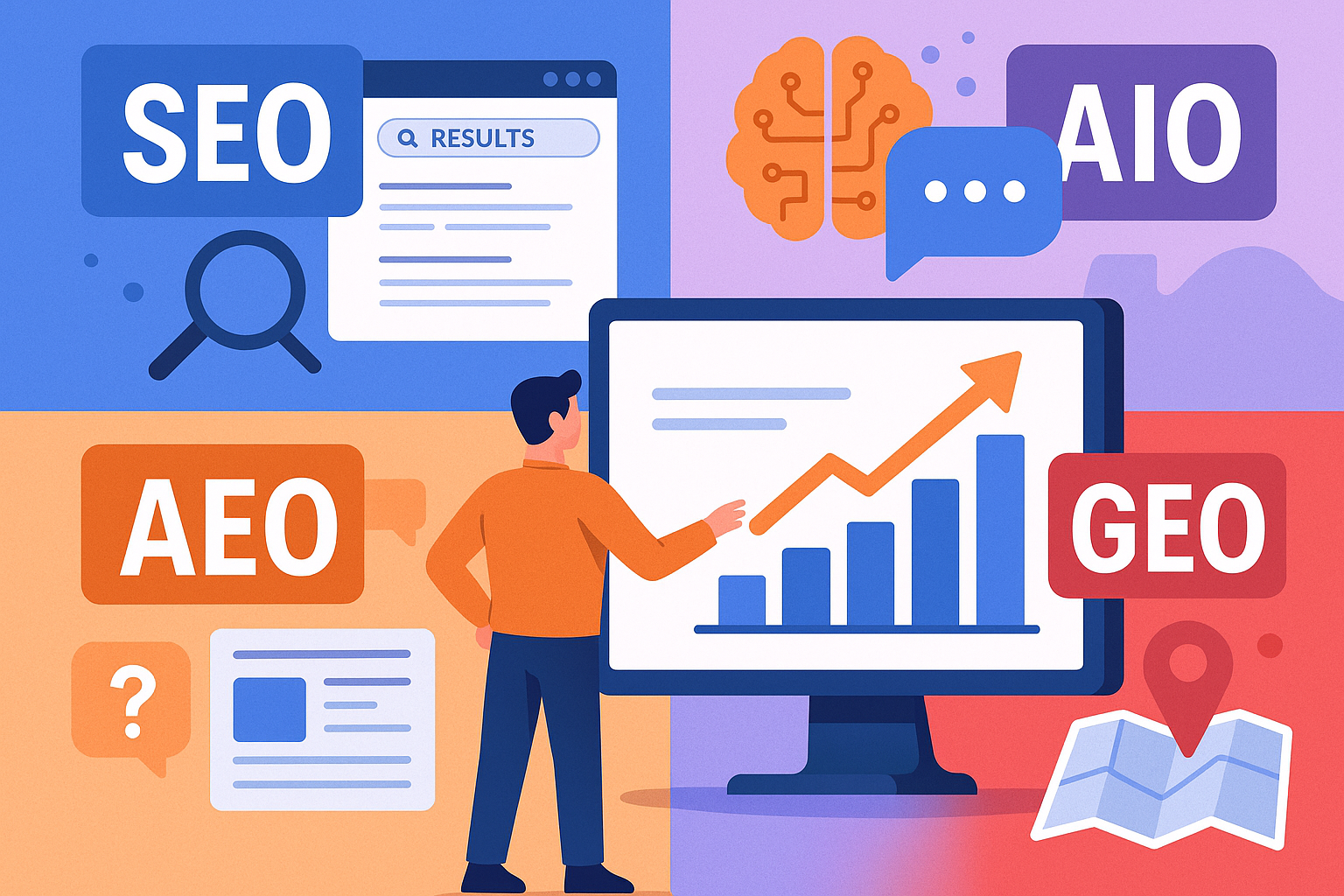
However, the rise of artificial intelligence and generative technologies has introduced new layers to the digital ecosystem: Artificial Intelligence Optimisation (AIO), Answer Engine Optimisation (AEO), and Generative Engine Optimisation (GEO). At first glance, these acronyms may seem confusing or even interchangeable, but each represents a unique shift in how users interact with digital content.
Today’s audiences no longer just search; they ask, converse, and expect instant, accurate answers. They engage with AI-driven chatbots, voice assistants, and AI-generated summaries that prioritise relevance and context over traditional ranking factors. In this environment, clinging solely to SEO principles is no longer enough. Businesses need to rethink their strategies and focus on results, not just labels.
SEO: The Foundation That Still Matters
Even as new technologies emerge, SEO remains the backbone of online visibility. SEO encompasses all efforts to ensure that websites rank prominently in traditional search engines, like Google or Bing. At its core, SEO is about aligning your content with what users are searching for, providing value, and making your site technically accessible.
SEO continues to drive organic traffic, form the foundation for digital marketing strategies, and acts as the gateway for integrating more advanced methods like AIO, AEO, and GEO. Without solid SEO fundamentals, the other strategies often struggle to achieve their full potential, making it a critical first step in any holistic online approach.
AIO: Harnessing AI to Enhance Content and Engagement
Artificial Intelligence Optimisation (AIO) builds upon SEO by leveraging AI tools to generate, enhance, and refine content. Unlike traditional SEO, which relies primarily on manual research and human creativity, AIO uses algorithms to analyse trends, predict audience behaviour, and even create content that aligns with specific user needs.
This can include generating blog posts, optimising social media content, or personalising landing pages for individual users.
AIO allows marketers to move beyond generic strategies and deliver experiences that are highly relevant and timely. It not only speeds up the content creation process but also ensures that content resonates with audiences on a deeper level. By understanding patterns in user interaction, AI can suggest content improvements, identify gaps, and predict which topics will perform best.
AEO: Structuring Content for Direct Answers
With the rise of voice search and AI assistants, Answer Engine Optimisation (AEO) has become increasingly critical. AEO focuses on creating content that provides direct, concise, and accurate answers to user queries. This strategy is particularly important in a world where search results are increasingly dominated by AI-generated responses, featured snippets, and voice assistants.
AEO is about understanding the questions your audience is asking and structuring content in a way that makes it easy for machines to extract and present information. This often involves breaking down content into clear sections, using headings strategically, and ensuring that answers are concise yet comprehensive.
GEO: Optimising for AI-Generated Summaries
Generative Engine Optimisation (GEO) represents the next frontier, focusing on ensuring that content is recognised and utilised by AI systems to generate summaries, insights, or content for end-users. Unlike SEO or AEO, which target human users directly, GEO targets AI engines themselves. It’s about producing authoritative, high-quality content that AI algorithms can reference, summarise, and present in response to user queries.
The principles of GEO emphasise semantic relevance, comprehensive coverage of topics, and trustworthiness. It’s not enough to just include keywords; content must demonstrate expertise and reliability. GEO ensures that when AI platforms generate summaries, your content is more likely to be included, cited, or highlighted.
SEO vs AIO vs AEO vs GEO: Key Differences
SEO (Search Engine Optimisation):
- Focuses on ranking websites in traditional search engines like Google.
- Optimises keywords, metadata, backlinks, and site structure.
- Drives consistent organic traffic and builds long-term authority.
AIO (Artificial Intelligence Optimisation):
- Uses AI tools to create, enhance, and personalise content.
- Predicts trends, identifies gaps, and improves engagement.
- Streamlines content creation while making it more relevant for users.
AEO (Answer Engine Optimisation):
- Structures content to provide direct, concise answers to queries.
- Optimised for voice search, chatbots, and AI assistants.
- Position your content as the authoritative response for users.
GEO (Generative Engine Optimisation):
- Optimises content to be recognised and referenced by AI systems.
- Ensures inclusion in AI-generated summaries, insights, and recommendations.
- Focuses on quality, semantic relevance, and trustworthiness for AI amplification.
Note:- These acronyms represent features and formats in modern search, not entirely new disciplines. If you’re already practising good SEO, you’re already covering them.
How to Decide Which Strategy Fits Your Goals
Choosing between SEO, AIO, AEO, or GEO isn’t about following the latest trend; it’s about aligning your efforts with what your business actually needs. The right strategy depends on where your audience is, how they search, and the results you want to achieve. Instead of getting lost in labels, focus on matching the approach to your goals.
User Intent & Content Surfaces
When people are still clicking into websites to browse products, explore services, or read detailed guides, SEO takes the lead. It’s the backbone of driving steady, high-quality traffic and turning searches into conversions.
If users are getting their answers instantly through AI snapshots, voice assistants, or conversational tools, that’s where AEO and GEO come in. These methods make sure your brand isn’t left out of the conversation even when the user never lands directly on your site.
For content that’s layered or knowledge-heavy, like how-to guides, comparisons, or multi-step instructions, AIO proves most effective. Well-structured and context-rich content makes it easier for AI systems to pick up, summarise, and feature your insights in overviews.
How SEO Differs from AI-Focused Strategies
SEO, or search engine optimisation, has long been the cornerstone of driving organic traffic. In contrast, strategies like GEO, AEO, and AIO are designed specifically for generative AI platforms. Their goal is to optimise your content for AI-driven recommendations and interactions rather than traditional search rankings.
As more consumers rely on AI tools for research, comparison, and decision-making, it becomes essential to ensure your brand is visible in these channels. However, this doesn’t replace SEO it complements it.
The most effective approach is to layer AI-focused strategies, such as GEO, onto your existing SEO efforts. Together, they create a synergy that maximises your brand’s reach, ensures consistency across both AI and organic search, and addresses gaps that might exist if you relied on only one strategy.
Let Performance Speak, Not Labels
The key takeaway is clear: the acronym doesn’t matter as much as the outcome. By combining solid SEO foundations with AI-powered enhancement, structured answers, and AI-recognised content, businesses can achieve tangible results, higher traffic, stronger engagement, and lasting trust. Focus on execution, strategy, and measurable impact, and your content will thrive across every modern platform.
Ultimately, it’s about creating value for your audience and ensuring your brand remains relevant in an ever-evolving digital landscape. Consistently delivering quality and meaningful content is what truly sets successful businesses apart.







Keep In Touch