

In the fast-paced digital world, driving traffic to a website is only half the battle. The real success lies in converting that traffic into meaningful actions, such as sales, leads, or sign-ups. This is where Conversion Rate Optimisation (CRO) comes into play. CRO is a strategic approach to increasing the percentage of website visitors who complete a desired action, ultimately improving ROI and enhancing the overall user experience.
CRO combines analytics, user behaviour research, A/B testing, and psychological principles to make websites more effective, rather than just focusing on design aesthetics.
Understanding Conversion Rate
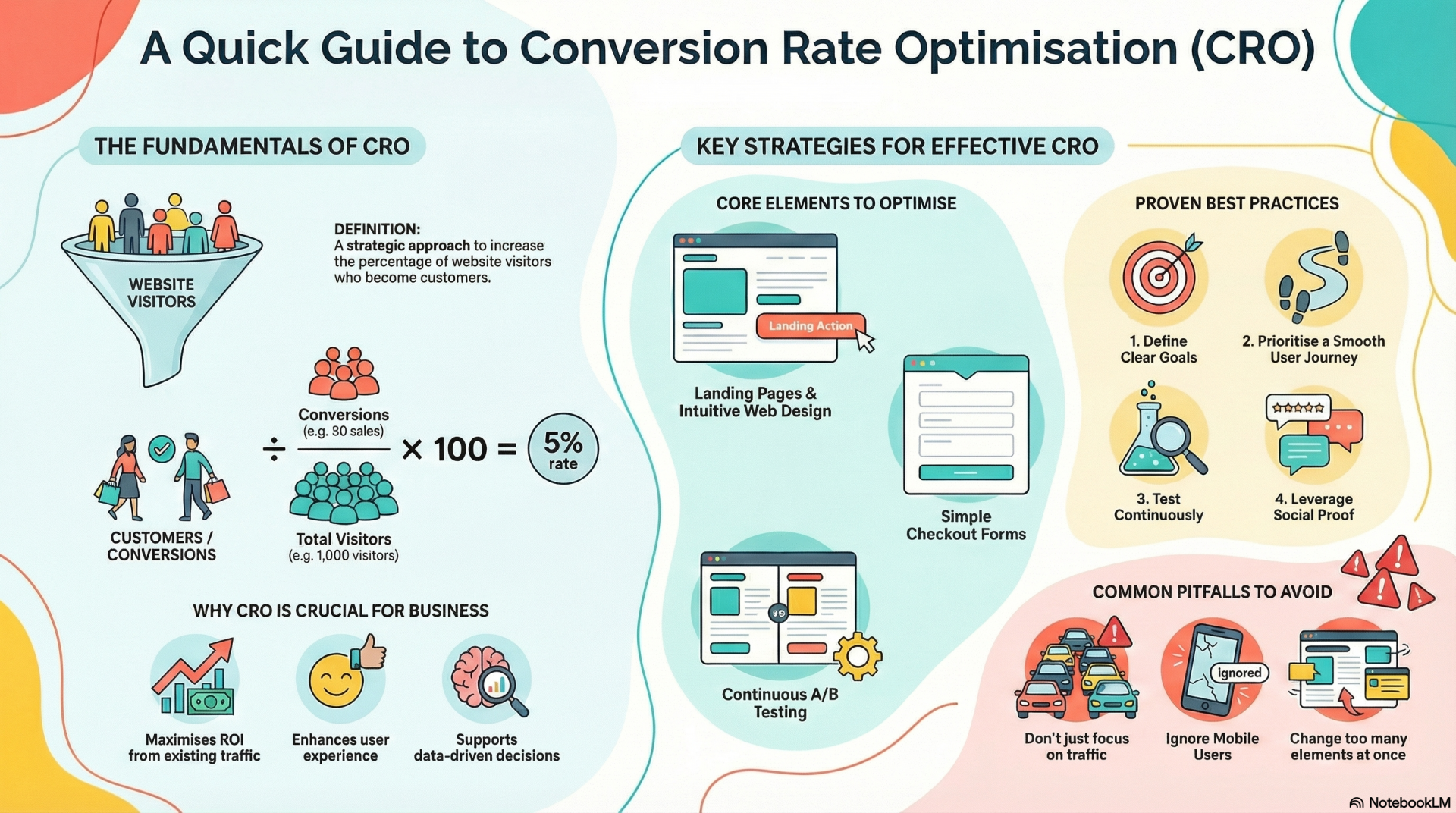
A conversion occurs when a website visitor completes a specific action aligned with business goals, such as making a purchase, filling out a contact form, or subscribing to a newsletter.
The conversion rate is calculated as:
Conversion Rate (%) = (Number of Conversions ÷ Total Visitors) × 100
Example:
If 1,000 visitors come to a website and 50 make a purchase:
Conversion Rate = (50 ÷ 1,000) × 100 = 5%
Why is CRO Important?
In today’s competitive digital landscape, simply attracting visitors to your website is not enough. Businesses need to ensure that their traffic converts into meaningful actions to maximise value. Investing in CRO provides multiple advantages for businesses:
Maximises ROI: Improve the performance of existing visitors rather than spending more on attracting new traffic.
Enhances User Experience: A conversion-optimised website reduces bounce rates and increases customer satisfaction.
Supports Data-Driven Decisions: Analytics and testing allow businesses to make informed, rather than guesswork-based, decisions.
Key Elements of Conversion Rate Optimisation
CRO involves improving multiple aspects of a website. The most impactful elements include:
1. Landing Page Optimisation
Optimising landing pages ensures visitors can quickly understand your offering and take action. Focus on:
- Clear headlines
- Strong calls-to-action (CTAs)
- Minimal distractions
- Trust indicators like reviews
2. Website Design and Usability
A clean, intuitive design encourages visitors to engage and convert. Consider mobile responsiveness, fast loading times, and easy navigation.
3. Forms and Checkout Optimisation
Forms are often conversion bottlenecks. Streamline them by reducing fields, offering guest checkout, and providing clear error messages.
4. A/B Testing and Analytics
Use A/B testing to compare variations of your website elements and track results using tools like Google Analytics or Hotjar. This helps identify what drives higher conversions.
Understanding User Behaviour
A crucial component of CRO is understanding user behaviour. By studying how visitors interact with your site, businesses can identify barriers to conversion. Analytics tools provide valuable insights into click patterns, scroll depth, and navigation flow. Heatmaps and session recordings show exactly where users focus their attention and where they drop off.
Understanding user behaviour also involves considering the psychological aspects of decision-making. Factors such as trust, perceived value, urgency, and social proof influence whether a visitor converts. By aligning your website design and content with these psychological triggers, you can significantly improve conversion rates.
Personalisation and Segmentation
Not all visitors are the same. CRO strategies that incorporate personalisation and segmentation tend to be more effective. Segmenting audiences based on demographics, behaviour, or previous interactions allows businesses to deliver targeted content and offers that resonate with different user groups.
For example, returning visitors might be shown product recommendations based on their browsing history, while first-time visitors receive introductory offers. Personalised experiences make users feel understood and valued, increasing the likelihood of conversion.
Best Practices for Effective CRO
To achieve consistent improvements in conversion rates, it’s important to follow proven strategies. Implementing these best practices ensures that your optimisation efforts are focused, effective, and deliver measurable results:
- Define Clear Goals: Know what actions you want visitors to take.
- Prioritise User Experience: Ensure a smooth, frictionless journey.
- Continuously Test and Iterate: CRO is an ongoing process.
- Leverage Social Proof: Reviews and testimonials build credibility.
Common CRO Mistakes to Avoid
Even experienced marketers can make errors when optimising conversion rates, which can limit the effectiveness of CRO efforts. One common mistake is focusing solely on increasing traffic without improving the user experience. More visitors don’t automatically translate into more conversions if the website is confusing, slow, or difficult to navigate.
Even experienced marketers can make mistakes when optimising conversion rates. Common pitfalls include:
Focusing only on traffic without improving user experience.
Ignoring mobile visitors, who often make up most of the traffic.
Changing too many elements at once makes it hard to track results.
Driving Business Growth with CRO
Conversion Rate Optimisation is not just a technical exercise; it’s a long-term business strategy. By continually analysing user behaviour, testing website elements, and refining the customer journey, businesses can turn casual visitors into loyal customers. A strong CRO strategy not only improves conversions but also enhances overall brand perception and trust, creating more meaningful relationships with your audience.
Implementing CRO Effectively
Implementing CRO effectively involves understanding your audience, identifying bottlenecks in the conversion process, and using data to inform decisions. Businesses that consistently optimise their websites see improvements not only in sales and leads but also in engagement metrics such as time on site, page views, and customer satisfaction.
Moreover, CRO complements other digital marketing efforts. Even the best SEO or paid campaigns will only be fully effective if the website is optimised to convert the incoming traffic. By focusing on CRO, companies can maximise the value of every visitor, reduce wasted marketing spend, and achieve a measurable increase in ROI.
CRO as a Continuous Journey
In essence, CRO is a continuous journey rather than a one-time task. The most successful businesses adopt a mindset of constant improvement, combining analytics, user feedback, and testing to refine their strategies. In today’s competitive digital environment, attracting traffic is just the beginning of turning those visitors into loyal, repeat customers is what drives sustainable growth, and CRO is the roadmap to achieve it.






Keep In Touch